Big Wild Goose Pagoda: Xi’an’s 1,300-Year-Old Icon
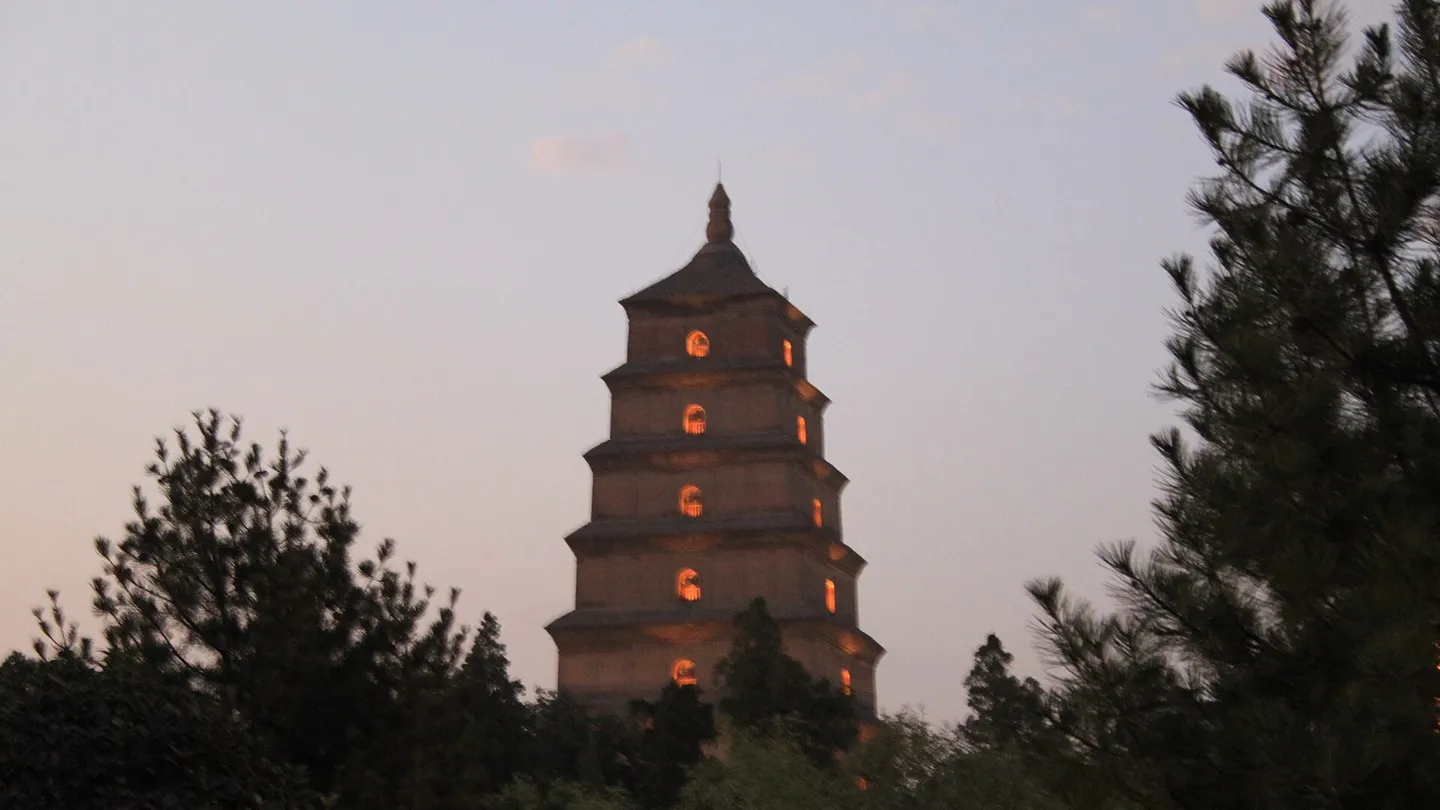
A 64-meter Tang Dynasty pagoda built to house Buddhist scriptures from India. Climb to the top for city views and stay for the nightly musical fountain show.
Written by Li Wei
History & Culture Writer · Xi'an since 2019
Li Wei has lived in Xi'an since 2019 and has visited every major museum and historical site in Shaanxi province at least three times. He spends his weekends exploring forgotten Tang dynasty ruins and reading Ming-era city maps. Before writing travel guides, he worked as a research assistant at the Shaanxi History Museum.
Opening Hours
8:00 AM – 6:00 PM
Pagoda. Square open until 10 PM
Ticket Price
$6
Students $3. Climb pagoda: +$4
Fountain Show
Free
Daily at 12:00, 20:00 (summer 21:00)
Time Needed
1–2 hours
Add 30 min for evening show
Best Time
Sunset
Climb for golden hour city views
Location
Yanta District
Metro Line 3/4, Dayanta Station
Architecture: 7 Stories of Buddhist Symbolism
The pagoda is a square brick structure in the typical Tang Dynasty style — simple, symmetrical, and massive. Each of the 7 floors tapers slightly inward, giving the pagoda its characteristic pyramid-like silhouette. The walls are 2-5 meters thick at the base, tapering to 1 meter at the top.
The number 7 is significant in Buddhism — it represents the 7 steps the Buddha took at birth, each one producing a lotus flower. Each floor has arched doorways facing the four cardinal directions, allowing light to pass through the entire structure. On each floor, carved stone panels depict Buddhist scenes and Tang Dynasty life.
Why the Big Wild Goose Pagoda Matters
Built in 652 AD during the Tang Dynasty, the Big Wild Goose Pagoda housed Buddhist scriptures brought from India by the monk Xuanzang — the real-life inspiration for the Monkey King’s master in Journey to the West. At 64 meters, it was one of the tallest structures in Tang-era China.
The pagoda has survived 1,300 years of earthquakes and wars. It leans slightly west — about 1 meter off-center from centuries of ground settling. Climb the 7-floor internal staircase for panoramic views of modern Xi’an with the old city wall in the distance.
The pagoda sits in the Da Ci’en Temple complex, a working Buddhist temple. South of the pagoda is the North Square, home to Asia’s largest musical fountain — a nightly water-and-light show set to classical Chinese music. It is free and draws huge local crowds.
At night, the area transforms into Great Tang All Day Mall (大唐不夜城), a pedestrian street of Tang-style buildings lit with red lanterns, street performers in period costume, and open-air food stalls. One of the most photogenic spots in Xi’an after dark.
Insider Tips
Climb at sunset. The top floor faces west. Go up 30 minutes before sunset for golden light on the city and watch the fountain lights turn on below.
Fountain show timing. Daily at noon and 8 PM (9 PM Jun-Aug). Arrive 20 min early for a front spot on the north elevated platform.
Skip the daytime crowds. Pagoda busiest 10 AM–2 PM. Come at 4 PM: climb the pagoda, explore the temple, then stay for the fountain show. One trip, two experiences.
Walk south after the show. The Great Tang All Day Mall pedestrian street stretches south from the pagoda. Street food, costume rentals for photos, live music. Lively until midnight in summer.
Nearby
China’s best provincial museum. Free with advance booking. Tang Dynasty gold and jade.
Tang Dynasty theme park with night performances. $18. Best after dark.
Xi’an’s busiest commercial district. Good for a break.
Related Attractions
Pair these with your visit for the best itineraries.
FAQ
How much does it cost?
$6 for the temple grounds. An additional $4 to climb the pagoda (7 floors, narrow stairs, no elevator). Students and seniors get 50% off. The musical fountain show in North Square is free.
Is it worth climbing?
Yes, if you are reasonably fit. The stairs are steep but the view from the top is one of the best in Xi’an — you can see the city wall, Bell Tower, and on clear days the Qinling Mountains to the south.
When is the fountain show?
Daily at 12:00 noon and 8:00 PM (9:00 PM Jun-Aug). Each show runs about 20 minutes. Best viewing: elevated platform on the north side. Arrive 20 min early.
What is inside the pagoda on each floor?
The 7 floors each have a theme. Floor 1: Xuanzang's journey map. Floor 2: Buddhist relics. Floor 3: Tang Dynasty coins and artifacts. Floors 4-5: smaller exhibits. Floor 6: bell you can ring. Floor 7: viewing platform with 360-degree city views. Windows on each floor face all four directions.
How difficult is the climb?
The stairs are narrow wooden steps, about 60 cm wide. No elevator. The climb takes 5-10 minutes for someone reasonably fit. There are rest platforms between floors. Not recommended for those with mobility issues, claustrophobia, or small children. The temple grounds alone are worth visiting even if you skip the climb.
Is the Great Tang All Day Mall worth visiting?
Yes, especially at night. The pedestrian street south of the pagoda is lined with Tang Dynasty-style buildings, red lanterns, and street performers in period costume. Free to walk. Very popular with Chinese tourists and great for photography. The best time is 8-10 PM when the lights are on.
Xuanzang: The Monk Behind the Pagoda
The pagoda was built to honor Xuanzang (602-664 AD), one of the most important figures in Buddhist history. In 629 AD, defying an imperial travel ban, he set out alone from Chang'an (Xi'an) on a 17-year, 25,000-kilometer journey to India to collect original Buddhist scriptures. He crossed the Gobi Desert, the Tian Shan mountains, and survived bandit attacks, snowstorms, and near-starvation.
When he returned in 645 AD, he brought back 657 Sanskrit texts, 150 relics, and 7 statues. Emperor Taizong built the Big Wild Goose Pagoda to house the scriptures and a translation academy where Xuanzang spent the rest of his life translating 74 texts into Chinese. His journey became the inspiration for the classic novel Journey to the West — the Monkey King story that every Chinese person knows. A statue of Xuanzang stands in the square south of the pagoda.